
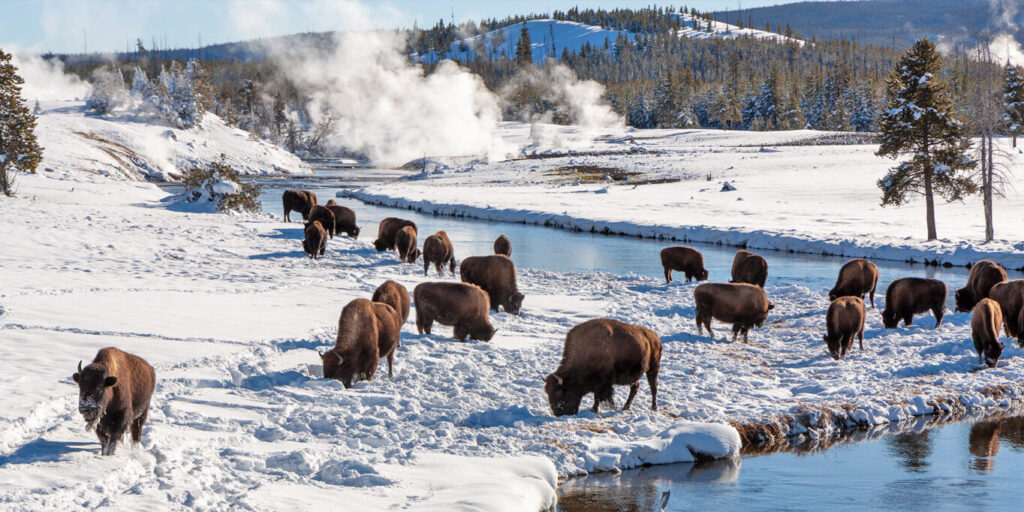
If you ask our guides when Yellowstone truly feels wild, we’ll point you to the stretch between December and March. With roads groomed for over-snow travel, steam rising off the Firehole River, and wolf tracks stitched across fresh powder, winter strips the park down to its essentials. Crowds thin, animals stand out against the snow, and the pace slows to something closer to how wildlife actually lives here.
At Wildlife Expeditions (the original tour provider in Yellowstone and Grand Teton since 1999), our biologists and naturalists spend the winter leading Yellowstone snowcoach tours and Winter Yellowstone wildlife tours. Below is a practical and educational guide to why winter is the best season to visit and how to make the most of a guided snowcoach day.
Why Winter Works: The Short List
Fewer People, More Signal
You’ll see more behavior with fewer vehicles around. That means more time to observe a bison clearing snow or a coyote mousing without pressure to move on.
High Visual Contrast
Dark coats on white snow make wildlife easier to spot: bison, elk, moose, pronghorn (in accessible areas), foxes, coyotes, and, with luck, wolves.
Predictable Travel Corridors
Animals key in on wind-scoured ridges, thermal areas, and plowed or groomed routes where snow is shallow. You can plan for those patterns.
Thermal Features At Their Best
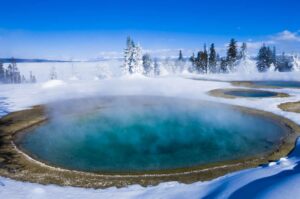
Cold air amplifies steam, rime ice, and hoarfrost. The geyser basins and the Grand Canyon of the Yellowstone cut sharply into the snowpack, making them prime locations for photography.
Where You Can Go in Winter (and How)
Yellowstone’s interior roads are closed to regular traffic in winter. Access is by snowcoach or snowmobile (authorized tours only). The northern road from Gardiner to Cooke City, via Mammoth, Tower, and Lamar Valley, remains open to wheeled vehicles year-round, weather permitting.
Snowcoach Access (Guided)
Old Faithful & Upper Geyser Basin
Wildlife en route often includes bison and coyotes; the basins are prime for steam-in-snow images.
Madison–Firehole–Fountain Paint Pot corridor
Consistent bison activity along warm rivers and thermal meadows.
Canyon & Hayden Valley (Conditions Permitting)
Wide, open country is ideal for spotting wildlife in motion.
Wheeled Vehicle Access (Plowed)
Lamar Valley
The best all-season shot at Yellowstone wolf spotting in winter with experienced spotters, plus bison, elk, and fox.
Starting in Jackson, WY, winter routes typically travel north into Grand Teton National Park for moose and elk viewing, then continue to Yellowstone over authorized winter corridors. When comparing Jackson, WY, to Yellowstone winter tours, consider factors such as transfer logistics, daylight hours, and your interest in visiting both parks on the same day. We can advise on realistic timing.
What Animals Are Doing in Winter (and How That Helps You See Them)
Our goal isn’t just to “check the box” on species; it’s to ensure their conservation. It’s to explain why you’re seeing what you see. A few quick field notes:
Bison
Large herds move to wind-blown ridges and thermal meadows where snow is thinner. You’ll often watch them use their heads to “plow” for forage. In deep cold, you may see steam condense on their forequarters, classic Yellowstone bison winter viewing scenes.
Wolves
Snow levels the playing field. Ungulates expend more energy traveling and foraging; wolves, on the other hand, can move efficiently on a hard crust. In mid-winter, packs travel widely. Sightings come from good scouting, patience, and shared observations among professionals. Tracks are often the beginning of a sighting, not the end.
Elk
Many shift to lower, wind-exposed slopes or thermal areas where forage is accessible. Expect to see them in mixed groups; bulls that retain their antlers can be especially photogenic in the snow.
Coyotes & Red Foxes
Watch for the “mouse pounce”, ears triangulating under the snowpack, then an arcing leap. Snow makes that behavior easier to see and photograph.
Trumpeter Swans, Bald Eagles, and Dippers
Open water along warm rivers attracts birds; eagles often target winter-weakened fish or carcasses.
Evidence Note
Research in Yellowstone has documented seasonal variation in wolf–elk dynamics, bison use of geothermal areas in winter, and thermal influences on vegetation and insect activity that cascade to ungulates and predators. Long-running sources include the Yellowstone Wolf Project Annual Reports and National Park Service winter ecology summaries. These align closely with what our guides observe every week.
The Snowcoach Advantage
If you’re after guided snowcoach tours in Yellowstone National Park, here’s what to know:
Comfort And Safety
Enclosed, heated vehicles with elevated views keep you warm and above the snow surface. You can step out at stops without punching through deep drifts.
Flexible Pacing
Good operators build time for actual observation, not just drive-by views. We prioritize safe pull-outs with sight lines that support longer watches.
Optics and Instruction
We offer high-quality spotting scopes and binoculars, and provide coaching on how to use them effectively in cold conditions.
Route Matching
Each day is different. We pair recent wildlife intelligence with weather, snowpack, and daylight to efficiently reach the highest-probability zones.
Winter Wildlife Spotting Tips (That Actually Help)
Layer Like A Local
Think moisture-management first. A breathable base, an insulating mid-layer, and a windproof outer shell are better than one heavy coat. Bring a dry spare base layer in a zip bag.
Protect Hands And Eyes
Thin liner gloves worn under insulated mitts allow you to operate camera dials briefly without freezing. Sunglasses reduce snow-glare fatigue; clear lenses help at dawn.
Manage Heat At The Core
A warm torso helps preserve dexterity in the fingers for focusing and adjusting exposure.
Move Quietly
Sound travels farther over snow; minimize door slams and voices. Our guides coordinate when to step out and when to stay put to ensure the comfort of wildlife.
Use The Wind
Stand downwind when possible; it drops scent and carries guide instructions toward you, not toward animals.
Glass The Edges
Look where timber meets meadow, where wind scours a ridge, or where steam meets cold air. Predators patrol edges; prey feed there.
Read Tracks First
Fresh, sharp-edged tracks with visible nail marks (canids) or splayed hooves (ungulates) tell you who’s been active and how recently.
Photography in Winter: Practical Settings
Exposure
Snow fools meters. Start at +0.7 EV exposure compensation to avoid gray snow. Check the histogram; protect highlights around steam.
Shutte Speed
1/1000s for moving animals; 1/250–1/500s for static scenes. Raise ISO rather than losing sharpness.
Tripod/Monopod
Useful at roadside stops; in deeper snow, a monopod is faster to reposition.
Lens Management
Keep one telephoto mounted. Switching lenses in steam and snow can invite condensation or frost on the elements.
Battery Care
Cold temperatures can quickly damage batteries. Carry spares in an inside pocket close to body temperature.
Snowcoach vs. Summer: What’s Different (and Why It Matters)
Field of View
In summer, tall grass and leafy willows obscure low-profile wildlife. Snow lowers the visual “noise,” making behavior easier to read at a distance.
Behavior Windows
Predators often remain mobile longer into daylight in winter, whereas in summer, many shift back to crepuscular or nocturnal patterns due to heat and human presence.
Thermal Drama
Steam plumes, rime-coated trees, and snow bridges are winter-only. These become foreground or background elements for images that simply don’t exist in July.
Pacing
Winter tours trade total miles for quality time at key locations. You’ll cover fewer areas, but often get a deeper look.
Seasonal Travel Tips for Snowcoach Tours
Clothing Checklist
- Wicking base top/bottom, insulating mid-layer, windproof shell
- Insulated boots with real tread, wool socks (plus a spare pair)
- Warm hat that covers ears, neck gaiter, or balaclava
- Liner gloves + insulated mitts
- Chemical hand/toe warmers for long stops
- Sunglasses or goggles for glare and wind
Pack Smart
- Water that won’t freeze (insulated bottle or warm tea)
- High-calorie snacks you can eat with gloves on (bars, nuts)
- Phone in an inside pocket; cold shortens battery life
- Small dry bag for optics or layers during snowy stops
Safety & Etiquette
- Keep legal distances: 25 yards from most wildlife; 100 yards from bears and wolves.
- Let wildlife set the timeline. If a herd needs space, we move.
- Follow the guide instructions on when to exit the vehicle and where to stand.
- Never feed wildlife; human food alters their behavior and can harm animals.
Example Winter Day with Wildlife Expeditions
Pre-Dawn Departure (Jackson, WY)
We check overnight wind, temperature, and recent sightings from our guide network and the conditions desk.
Transit Scouting
We glass river corridors for swans, eagles, and early coyote movement, then commit to our primary route, often the Madison–Firehole corridor or Canyon area by snowcoach.
Observation Blocks
We build in longer stops where tracks, wind, and light align. If an opportunity arises (such as distant wolves on a ridge), we adjust the plan.
Education in Place
While you’re on the scope, we explain what you’re seeing: why bison choose a wind-blown bench, how crust thickness affects movement, and why ravens are circling that draw.
Wrap With Purpose
We conclude with a recap of the conditions that taught us that day and how they shape tomorrow’s plan.
FAQs
Is Winter Too Cold To Enjoy?
With proper layers and a warm snowcoach to rotate into, guests usually stay comfortable. We structure stops to match conditions and daylight.
What Are The Chances Of Seeing Wolves?
Never guaranteed, always possible. Winter increases odds thanks to visibility and snow tracking. Success depends on conditions, time spent scanning, and recent pack movements.
Are Snowcoach Tours Suited To Photographers Or Families?
Both. We plan for flexibility, families get comfort and safety; photographers get time windows and guidance from educators who understand fieldcraft.
Ready to Experience Winter Right?
Yellowstone in winter isn’t about checking off miles; it’s about seeing more by doing less, and having a professional educator next to you translating tracks and behavior into a story you’ll remember.
Plan your trip with Wildlife Expeditions:
- Guided snowcoach tours in Yellowstone National Park
- Best Yellowstone snowcoach tours in winter routes tailored to conditions
- Jackson, WY, to Yellowstone winter tours with educator-guides, scopes, and warm vehicles
Learn more and request dates at wildlifeexpeditions.org. We’ll help you choose the right itinerary, pack the right layers, and make the most of winter’s best wildlife season.