The Tetons’ scale leaves a lasting first impression. For watercolor artist Sarah Yeoman, the mountains brought new colors, a sense of scale, and a different quality of light. But arriving at the Murie Ranch, she found herself drawn to something more intimate: the historic cabins and the stories held within their walls.
This October, we welcomed Sarah as our first artist-in-residence during the inaugural Murie Ranch Art Festival. The festival brought artists, families, and community members together to explore creativity in a place that has inspired generations. For Sarah, the residency offered time to get to know a new landscape and learn about the people who had called it home.
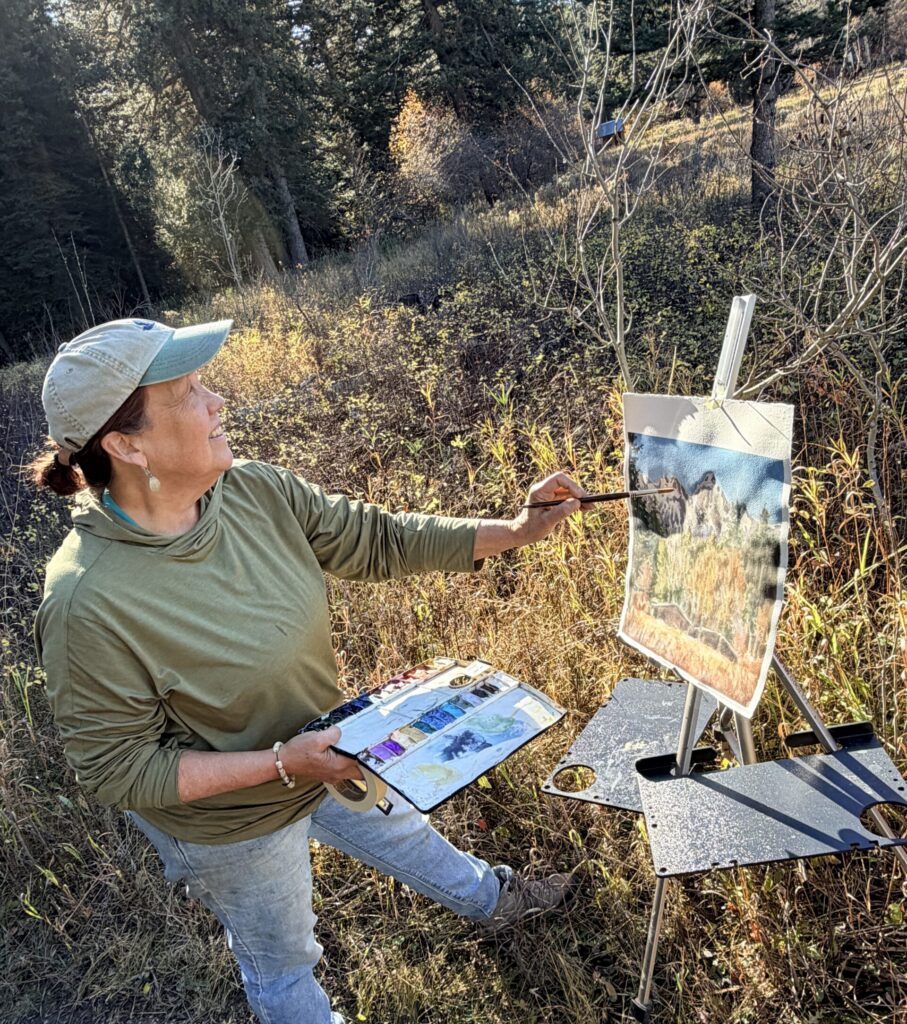
Much of Sarah’s painting takes place in the Adirondacks, where shallow streams and kayakers are familiar subjects in her landscape watercolors. Arriving in Jackson meant taking in a different landscape. Even before putting brush to paper, she was composing paintings in her head, noticing the relationships between light, shadow, color, and shape. Sarah explained that it takes her four or five days to begin settling into a new place, learning its colors, shapes, and sense of scale. With so much to take in, part of her work is deciding what speaks to her most strongly and what she feels most compelled to express through paint. At the ranch, that attention kept returning to the buildings. Their history and intimacy offered a way into the landscape, with the Tetons serving as a backdrop to the stories she wanted to tell. The cabins became part of her landscape paintings, connecting the surrounding land with the lives and work of the Muries.
Before arriving at the ranch, Sarah had not been familiar with Olaus and Mardy Murie. During her stay, she learned how their home became a gathering place for people working to protect wilderness, and how closely their lives and work were connected to the surrounding land. Olaus expressed that connection through science, writing, and art, making the invitation to paint in his studio especially meaningful. Teton Science Schools had recently restored the space to display his artwork and offer visitors a sense of the studio as he knew it. To the best of the ranch and TSS staff’s knowledge, Sarah was the first artist since Olaus to paint in the studio. She described the opportunity as an honor to create in a space whose history she was only beginning to discover.
The festival celebrated the connection between art and nature that shaped Olaus’s work. Sarah explored that connection by closely observing the ranch’s buildings, aspens, and changing light. Rain and chilly temperatures shaped her experience, too. Painting outdoors sometimes required a hat and gloves, but the gray days offered their own possibilities. Beneath an overcast sky, Sarah found beauty in the aspens and the subtle shifts between light and dark. Those conditions became part of her watercolors’ mood.
Although the Tetons were new to her, getting to know them felt familiar. As in the Adirondacks, she learned through spending time outside, painting repeatedly, and paying attention to color and shadow. For Sarah, painting begins with a feeling about a place and the desire to express something that words cannot quite convey. Sharing that process with visitors became another rewarding part of the residency. During the art festival, Sarah painted with children and talked with guests about how she sees the world through composition, lighting, shapes, and value. These conversations offered a chance to share the observation and thought that begin long before a brush touches paper. Some visitors also had connections to the Adirondacks, bringing unexpected moments of familiarity to her time in the West. In a landscape so grand in scale, it’s easy to forget how small a world it really is.
By the following Thursday’s Out & About event, Sarah had several more paintings to share and more experiences to reflect on. The intimate gathering gave visitors room to ask thoughtful questions about her work, her impressions of the West, and the choices she makes while painting. During the conversation, she shared a reminder that guides both her art and her teaching: “You can never make a mistake in something that’s never existed before.” After years of teaching, Sarah has found that fear of failure can keep people from beginning. She encourages students to play, trust themselves, and let a painting develop without becoming too attached to the outcome. The back of the paper or another sheet is always waiting for a fresh start.
Her final days at the ranch brought an unexpected test of that outlook when a skunk sprayed her belongings, including some of her artwork. Looking back with humor, Sarah connected the experience to the same practice of letting go. She could always paint again! That openness will also guide the work she continues at home. Her photographs and sketches offer ways to revisit the ranch and develop ideas that still hold her attention. Sarah feels the Murie Ranch deserves more paintings, and she has more she wants to express about her time there.
We are grateful to Sarah for sharing her work and her way of viewing the world during this first residency. Through her paintings and conversations, she invited visitors to look more closely at the Murie Ranch and consider how its stories, buildings, and changing light might inspire their own creativity.