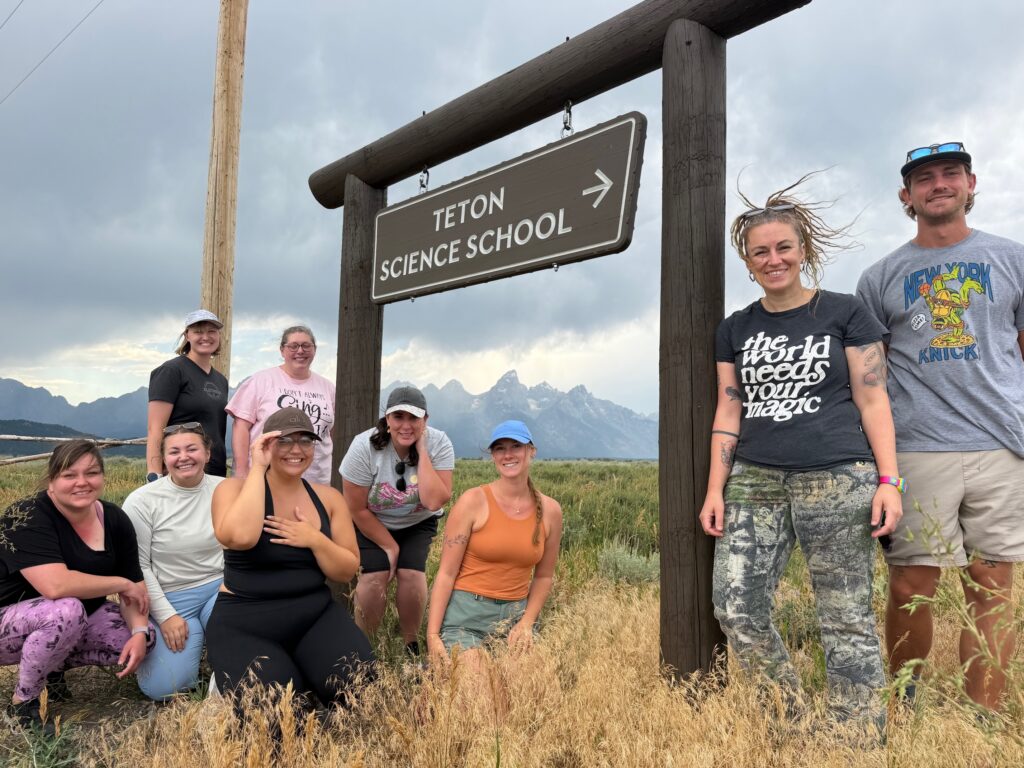
This summer, our Professional Learning Team welcomed a group of junior high educators from Maria Montessori Academy out of North Ogden, UT, for a three-day Place-Based Education experience at Teton Science Schools. From the moment they arrived, they were learning in place – connecting over their own sense of belonging and considering what makes a place more than simply a location. Their learning moved beyond the classroom and into the landscapes, stories, people, histories and possibilities of place.
Across the three days, educators experienced many of the same kinds of learning experiences we hope to create for students. They created sound maps, sat quietly in a “sit spot,” and explored Grand Teton National Park through the lenses of ecology, culture, and history, and what makes a place unique. A landscape sketch encouraged them to slow down and notice, an aspen scavenger hunt prompted close observation, and anthropomorphic storytelling invited them to see the familiar from a different perspective. These experiences echoed a central Montessori idea: meaningful learning begins with direct encounters with the world and extends learning environments into the outdoors, designed to support purposeful engagement, exploration, independence, and stewardship.
The experience was not simply about experiencing place. It was about transforming that experience into possibility. On the final day, educators returned to the question: How might we use the unique stories, ecology, culture, and economy of our own communities to design meaningful learning experiences for students? They identified local assets, considered community connections, developed place-based learning ideas, and designed projects rooted in their own Utah communities. They left with more than a collection of activities. They left with a different way of seeing their communities as sources of questions, knowledge, relationships, and learning. In many ways, this is where Montessori and Place-Based Education meet: both invite us to look carefully at the learner and the environment, to resist doing all the telling, and to create conditions in which curiosity can lead somewhere. These educators returned to their schools not simply with new lessons, but with a renewed sense of what becomes possible when place becomes part of the learning environment.