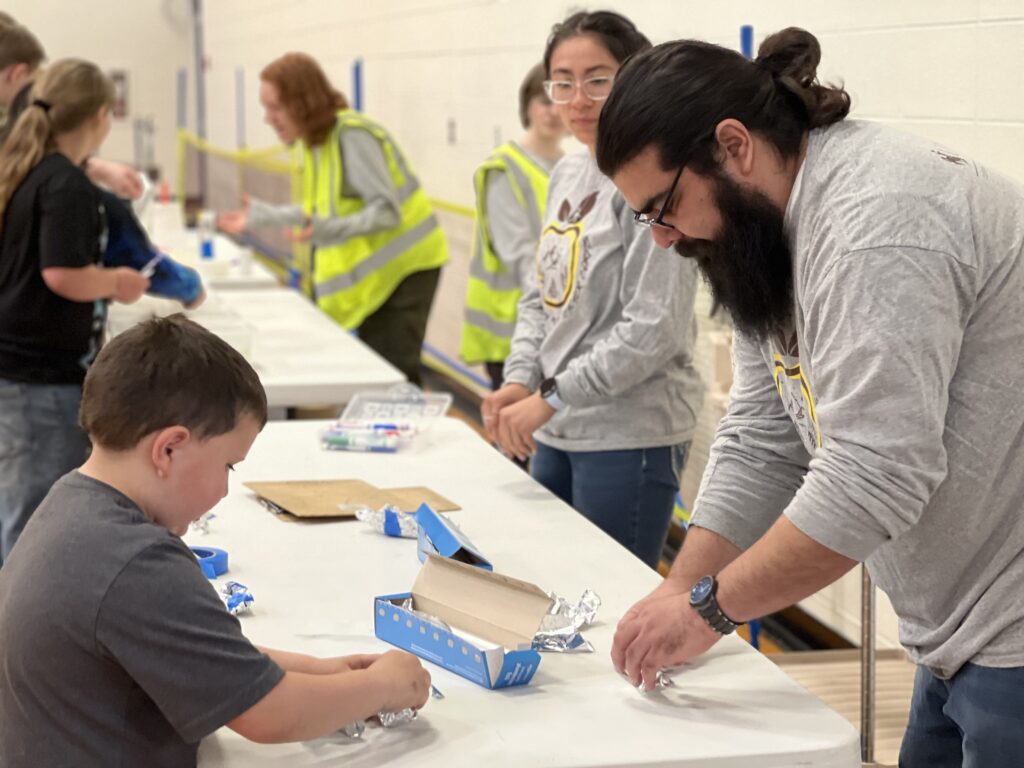
The Wyoming Rural Teacher Corps is a partnership between Teton Science Schools and the University of Wyoming’s College of Education that seeks to recruit and prepare college students for rural teaching careers. This is the 4th year that the Wyoming Rural Teacher Corps has been running, and so far, 15 WY Rural Teacher Corps members have graduated from the University of Wyoming and begun teaching jobs.
In this blog, hear from 3 WY Rural Teacher Corps (RTC) members who completed their student teaching in the fall of 2025 and graduated in December 2025 about their experiences in the Corps and with rural teaching.
Please share your name, your university major, and where you live now.
Jacie Friel, Elementary Education with a minor in English as a Second Language, living in Pinedale, WY.
Kialie Staggs, an Elementary Education student in Laramie, WY, is moving to Green River in March.
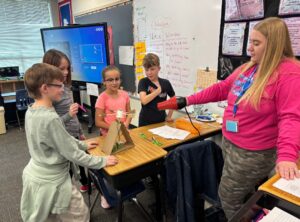
Torin Chavez, Elementary Education, now living in Cheyenne, WY.
Why did you join the WY Rural Teacher Corps?
Jacie: I joined the Wyoming Rural Teacher Corps because I was interested in seeing more schools across Wyoming and learning about how education is different in rural communities. I did most of my schooling in a suburban area, and so I wanted to better understand rural schools (specifically elementary) and find schools/districts that I would want to apply to in the future.
Kialie: I thought it’d be an amazing opportunity to utilize and be a part of something that would give me experience in smaller classrooms, knowing that’s where I’ll end up living. I’m planning to stay in Wyoming, and Wyoming, for the most part, is rural. So I thought it would be a good experience for my future.
Torin: When I saw a presentation for the WY Rural Teacher Corps, I just happened to be in my second semester back in college after about 8 years of putting school on hold. I wanted to fully dive into my degree field and explore the opportunities that college had to offer. This was something I didn’t focus on the first time I went to UW. RTC sounded interesting because I knew little about the rural areas in Wyoming, and I thought this would be a great way to learn more about this specific area of education.
What does rural mean to you?
Kialie: To me, rural can mean many things. It can mean secluded. It is small. It can be a tight-knit and very community-based and personable.
Torin: Rural to me has changed meaning. It once meant to me the middle of nowhere. I always imagined a small “blink, and you miss it” town that consists of a gas station and an adjacent diner. Now, rural means to me an area where communities have meaning, and the people look out for each other. Somewhere that half the town knows you’re new, even though you’ve only met one person.
Jacie: To me, rural means that an area has a low population of people but is spread over a larger amount of land. I also think of rural areas as a lot of small towns close together, but no large suburban/urban area nearby. Another aspect of rural life for me is that the communities are close, but they are also separate and disconnected from highly populated areas and resources. This means that rural communities have their own unique culture and history that is often not represented or conveyed accurately in a variety of media.
What has been one of the most impactful experiences for you, being a part of the WY Rural Teacher Corps?
Torin: One of the most impactful experiences for me, being part of the Wy Rural Teacher Corps, is being able to see rural schools firsthand. The program offers the opportunity to visit and see rural schools in Wyoming and one in Idaho. I always attended schools in the middle of Cheyenne, so seeing how rural schools run and look was an eye-opener. It helped me expand my view of rural areas and what they have to offer. These school visits helped me broaden my view on what kind of teacher I could be.
I was also fortunate enough to share my student teaching placement at a rural school with others in the program during a school visit. I found that experience impactful by being able to share my experiences with others as well, my own way of paying it forward.
Jacie: Some of the most impactful experiences from the WRTC for me were visiting Kelly Elementary School and Munger Mountain Elementary School in Jackson, Wy. In Kelly, I remember the students were learning about the Gros Ventre landslide, which I got to see as we were driving to the school, which helped me realize how meaningful place-based projects can be for students in learning about the things they get to see every day. Munger Mountain was also impactful for me because it was a rural school that really matched my interests and teaching philosophy. I got to ask so many questions and find a place that I would like to apply to in the near future.
Kialie: The thing that impacted me most was getting the opportunity to experience multiple different rural settings and getting to see that rural schools can be very different and unique, even though they are in small communities. The first-year retreat was helpful to see multiple different schools, especially being in Jackson, which is known to be a more populated part of WY. That was interesting to me because you don’t expect those bigger parts to have rural sections – on the outskirts of a town, there can still be rural areas.
How did you use what you learned about place-based education and rural teaching as a part of your student teaching?
Jacie: I used a lot of what I learned about place-based education as a part of my student teaching, much of which came in my responses to students. When students thought what they were learning was not useful or needed, I found the most effective way to explain its significance was by relating the concept to future careers and improving the community. I also used what I learned from the RTC in many of the projects I created for students, such as making maps of their community for social studies and connecting the activity to health standards that covered where to go to improve their health. As I started implementing more place-based practices into my student teaching classroom, I noticed that I started to make more connections between standards and how they apply to students’ communities, which made the planning process and what I wanted students to gain from my lessons clearer. I would also say that what I learned from the RTC influenced a lot of the strategies I used in my lessons, such as including more class discussions and critical thinking activities that related to problems in the students’ community.
Kialie: I specifically utilized the knowledge that hands-on, place-based scenarios can help students grasp a unique understanding of material. I planned my project around wind energy, knowing that WY is one of the biggest economic places for wind energy. You drive almost anywhere, and you will see windmills. Students definitely know about windmills. We were able to connect in math, science, and reading; students answered reading comprehension questions, watched videos, and then students got to build their own windmills. I actually worked with a company that I met in Georgia at the National Forum to Advance Rural Education, as a part of the WY Rural Teacher Corp – Stiix. They do place-based projects, and they sent me materials for a low cost for all 4 classrooms. All 4 classrooms got to build their own windmills. Students had a blast, and they loved the hands-on building; teachers appreciated having a lesson planned for them. The curriculum is usually very strict, and I was able to take a whole day to do this, rather than having to implement little-by-little. I worked with the University of Wyoming and the Wind Energy Research Center. The students were divided into smaller groups and got to interact with folks at the University. Overall, it was amazing.
Torin: When it comes to how I used what I learned about place-based education and rural teaching from RTC in student teaching, I dove headfirst. I was fortunate enough to be placed at a rural school, a small one-classroom building with six students. I did my best to keep in mind what I learned in the program when making certain lessons. Such as what the area has to offer and how I’m able to use it. This led to taking the students on a field trip to Laramie to the Geological Museum. That would tie into a larger STEM project the students worked on, which focused on how they could improve mapping technology for jobs in the community, such as ranching, farming, and hunting, all areas that the students have experience with.
What is next for you?
Torin: What’s next for me is that I have graduated with a degree in Elementary Education, and looking to stay in Wyoming to teach. Teaching at a rural school would be ideal, but I am happy with teaching at a city school as well. At the moment, I am staying in Cheyenne, but moving to another area in Wyoming is a possibility as well.
Jacie: My future plan is to start looking for schools to apply to for the fall by researching areas and districts I am interested in. I will also be working as an English Language Learning paraprofessional for the rest of the school year to get experience right away. I do know that once I have gotten a job and have moved, I will spend a lot of time learning about the economy, ecology, and culture of the area to prepare for teaching my first class!
Kialie: I am hoping to land a teaching job in the Green River or Rock Springs area. I have heard great things about Green River schools, and it would be easy to commute to Rock Springs if that is where there is a position. There’s a small school called McKinnon Elementary School – it’s a very small rural school in the Green River school district with about 14 students. My high school choir used to go and sing there as part of a “Tour of Schools”.
Anything else that you would like to share about the WY Rural Teacher Corps and/ or place-based education?
Kialie: It is a really great opportunity for building those connections in learning to teach and understanding how you can improve a student’s education. It’s definitely helped me and will be something that I take with me into the future.
Torin: Something I would like to share is that RTC gave me experience in an area of education that I knew almost nothing about. I made friends and connections with other educators. It led me to my student teaching placement, for which I am highly grateful for such a wonderful opportunity. The program is a way to have fun and to see what Wyoming has to offer. I was fortunate enough to also attend the National Forum to Advance Rural Education as a part of the RTC and saw what districts are doing in the rural communities all over the country. The RTC has opened many doors that have led to being a much better educator.