
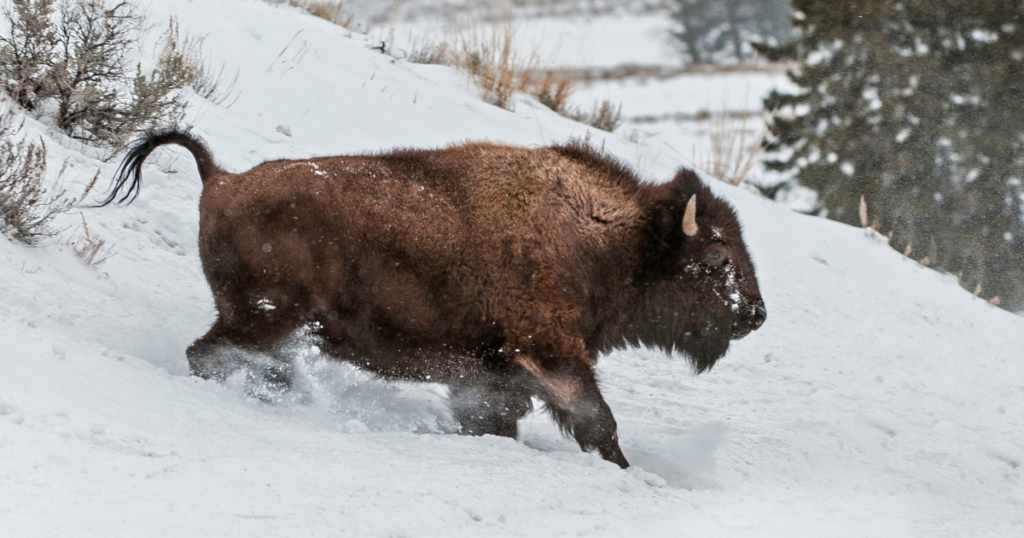
Bison are the undisputed icons of Yellowstone. Towering, shaggy, and built for survival, they embody the raw resilience of the park’s ecosystem. In winter, they become even more impressive, trudging through deep snow, steam rising from their thick coats, their heads sweeping aside drifts in search of buried grass.
If you’ve never seen a bison during the winter, you’re missing one of nature’s most unforgettable sights. On a Yellowstone snowcoach tour with Wildlife Expeditions, guests not only witness this scene but also learn about the ecological and behavioral adaptations that make bison true winter survivors.
This guide explores what it’s like to track bison in the snow and why guided snowcoach tours of Yellowstone in winter offer such a unique opportunity to see these animals in action.
The Yellowstone Bison: A Quick Overview
Yellowstone is home to the largest population of free-roaming, genetically pure bison in the contiguous United States, numbering about 5,000. Unlike cattle or domestic bison herds, these animals are fully wild, with their own migratory patterns and survival strategies.
Bison have roamed this land for thousands of years. They’re incredibly adapted to the harsh winters of the Greater Yellowstone Ecosystem, especially in places like Hayden Valley and Lamar Valley, where snow can accumulate over three feet deep and temperatures regularly dip below zero.
How Bison Survive Yellowstone Winters
Bison aren’t just enduring the cold; they thrive in it. Here’s how:
Dense Winter Coats
A bison’s winter coat is so thick that snow can rest on its back without melting. Beneath the long, outer guard hairs lies a dense underlayer that traps heat close to the body. According to the National Park Service, these coats offer enough insulation that snow accumulation doesn’t even cause heat loss.
Snowplow Heads
Instead of using hooves to dig through snow (like elk), bison swing their massive heads side to side, plowing snow to uncover grass underneath. This motion is so iconic in winter that you’ll often see entire groups of bison clearing patches in unison.
Slow and Steady Movement
Bison conserve energy by traveling in single-file lines through deep snow, especially when moving between thermal areas where snow is shallower due to underground geothermal activity.
Best Places for Bison Viewing in Winter
When you join one of our guided snowcoach tours in Yellowstone, we prioritize wildlife-rich areas where bison are most active. Some of the top winter viewing spots include:
1. Madison River Corridor
This geothermal-rich area remains relatively snow-free compared to other regions, drawing large groups of bison throughout the season.
2. Hayden Valley
Though harder to reach in deep winter, Hayden Valley is home to some of the largest bison herds. Steam from hot springs makes this a surreal place to observe animals moving through the mist.
3. Firehole and Gibbon Rivers
Heated by geothermal features, these rivers provide thermal refuges for bison and other species, making them ideal for photography and close observation.
Why Snowcoaches Are the Ideal Way to Explore
Winter access in Yellowstone is limited; most roads are closed to regular traffic. That’s where snowcoach wildlife tours come in.
Our custom-built snowcoaches are heated, comfortable, and equipped with large windows for optimal viewing. They’re built to navigate snow-covered park roads, making them the safest and most eco-friendly way to reach the park’s interior areas in winter.
Benefits include:
- Expert naturalist guides to interpret bison behavior and ecology
- Group spotting with binoculars and scopes provided
- Safe travel on roads inaccessible to the general public
- Photography stops in key locations
- Small group sizes for a more personal, educational experience
How Bison Behavior Changes in Winter
Understanding what you’re seeing enhances the experience. In winter, bison show a range of seasonal behaviors:
Migration
As snow deepens, bison move to lower elevations in search of accessible forage. Some even leave the park boundaries, though our tours focus on areas where they remain most active.
Energy Conservation
Bison reduce movement to conserve energy. You might see them resting more, often lying in snow hollows they’ve packed down with their body heat.
Group Dynamics
Winter herds are usually mixed-age and mixed-sex groups, but bulls tend to stay on the edges or be solitary during harsher months. In contrast to the dramatic rutting behavior of summer, winter herds are quieter, more coordinated, and focused on survival.
Guest Tip: What to Bring for a Winter Bison Tour
If you’re heading out with us on a Jackson, WY to Yellowstone winter tour, here’s what to pack:
- Insulated winter coat
- Gloves and a warm hat
- Waterproof boots with a good grip
- Neck gaiter or scarf
- A camera with a zoom lens or binoculars
- Notebook if you’re keen on naturalist journaling
- Hand warmers for cold stops
Our team also provides spotting scopes, snacks, and hot beverages, and of course, the deep ecological knowledge that makes every moment count.
Photography Tips for Yellowstone Bison in Winter
Winter photography in Yellowstone offers dramatic lighting and atmospheric conditions, steam vents, snowy fur, and crystalline air.
Here’s how to make the most of your snowcoach wildlife photography:
- Use telephoto lenses (at least 200mm) to respect wildlife distance regulations
- Shoot in burst mode to capture subtle behavior like snow-plowing
- Watch for contrast between dark bison and snowy backgrounds
- Try black-and-white mode for high-drama winter landscapes
- Be patient, the quiet moments often reveal the most telling behaviors
Winter vs. Summer: Why Bison Viewing is Better in Snow
Many visitors assume summer is the best time to see bison. But winter offers something different, something quieter, more intimate, and often more powerful:
| Feature | Summer Tours | Winter Snowcoach Tours |
| Accessibility | More roads open | Fewer crowds, remote areas reachable by snowcoach |
| Behavior | Mating season (rut), more active bulls | Migration, energy conservation, and snowplowing behavior |
| Scenery | Verdant meadows, rivers | Snow-covered plains, misty geysers, sharp light |
| Experience | Warmer, more hiking | Cozy vehicle, scenic driving, quiet solitude |
See the Giants of Winter for Yourself
Watching bison move through snow-covered Yellowstone is more than just a visual experience; it’s a window into resilience, adaptation, and the quiet strength of wild nature. These winter giants continue their ancient rhythms regardless of the weather, and with the right guide and gear, you can witness it all up close.
Ready to track Yellowstone’s winter wildlife in comfort and safety? Join one of our guided snowcoach wildlife tours and get a front-row seat to nature in its rawest, most beautiful form.
Book your Yellowstone winter tour today at wildlifeexpeditions.org